
Compost Before Crisis
Reflections on endings, tending + what comes next.
by Jess Solomon, MSOD
Every time I sit down to reflect on my six years of full-time entrepreneurship, something happens in the commons that turns my head away from the past and toward what's coming.
A longstanding cultural institution announces it is sunsetting, and it feels sudden even when sometimes it wasn't. Media outlets we rely on now rely heavily on AI. Leaders who held things together with shoestrings for decades retire without succession plans. Unlikely mergers arrive already decided. Someone we rely on takes a well-deserved sabbatical and we say out loud that we hope they come back.
I've noticed that most announcements about these major shifts and transitions communicate some version of the same thing: everything is fine. The work continues. The mission remains. The status quo holds.
But the status quo of how we lead, design, and grow organizations in this ecosystem, at what Grace Lee Boggs called "this time on the clock of the world," needs to be thrown in the compost heap.
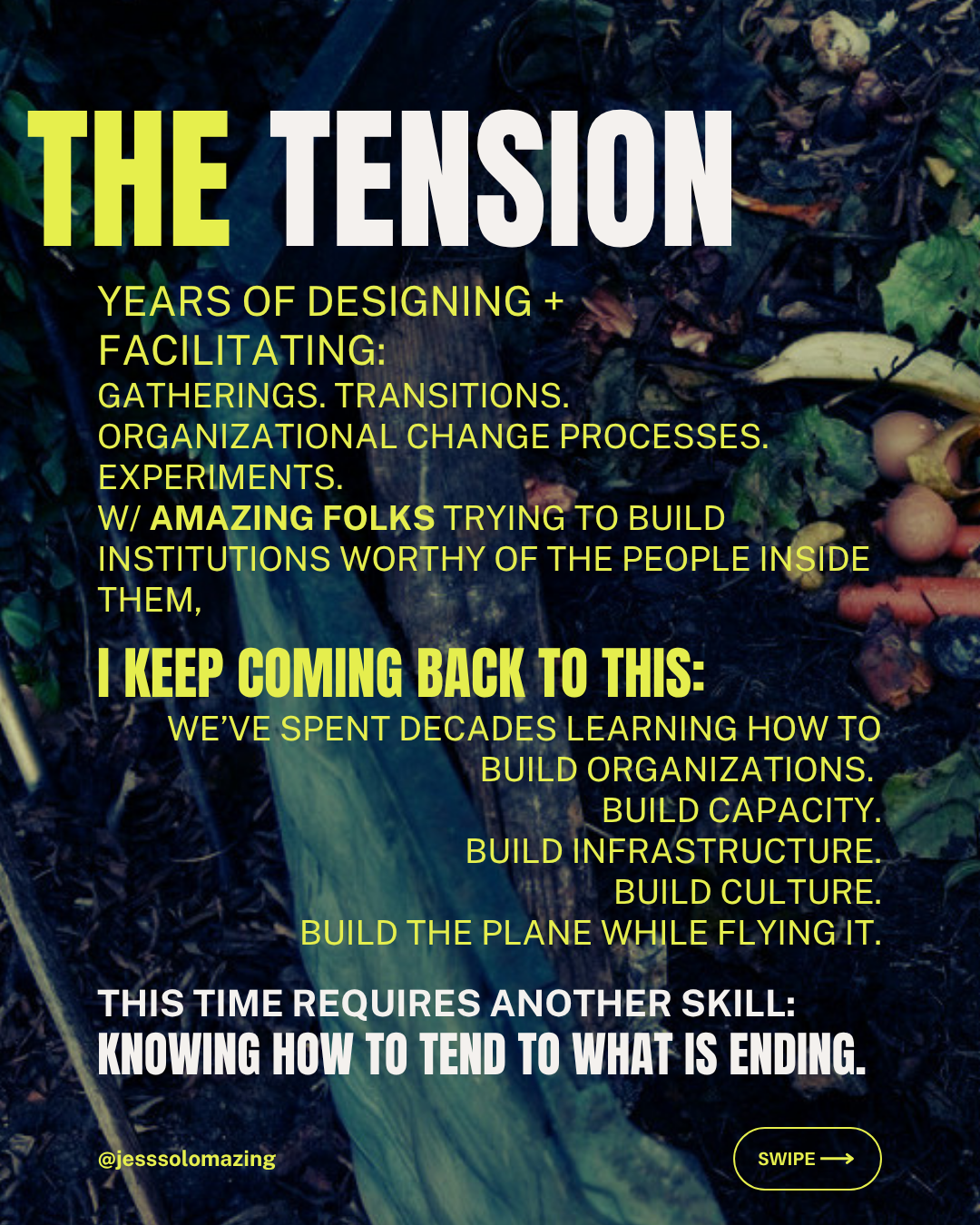
We have spent decades learning how to build organizations. I think the next era requires us to become just as skilled at tending what is ending. Not everything needs to survive.
May our most generative practices, relationships, stories, and ideas survive the decomposition process and become nutrients for organizations we may not yet know how to build.
Composting as an organizational practice, not a metaphor
We are accustomed to talking about organizational change through the language of building: build capacity, build infrastructure, build culture, build the plane while flying it.
Building assumes that the primary question is what we need to create.
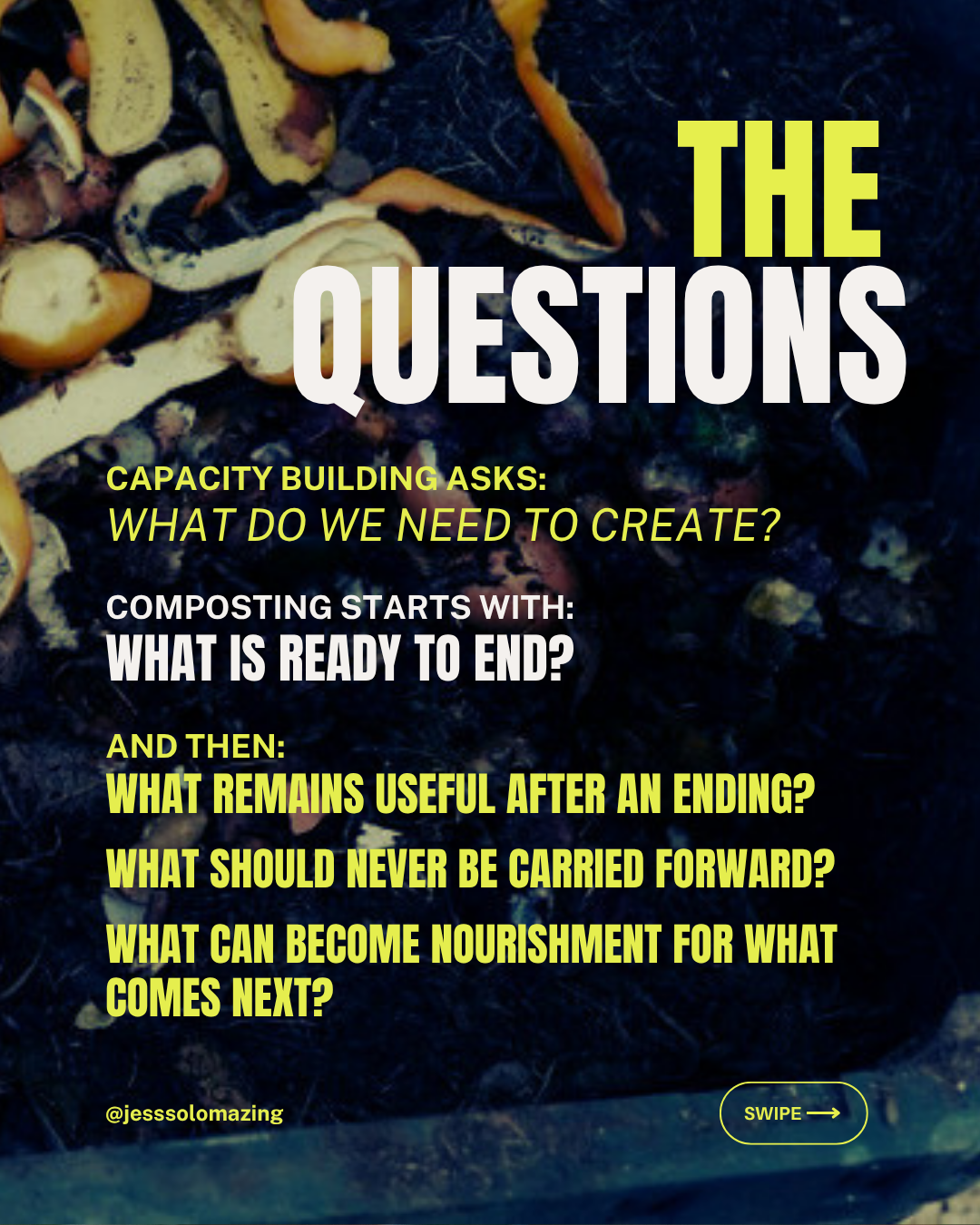
Composting starts with a different question:
What needs to end?
And then: What remains useful after an ending? What should never be carried forward? What conditions allow what is breaking down to become nourishment for what comes next?
Actual composting requires discernment and tending. You don't throw everything into a pile and wait for soil. The pile needs the right balance of material, moisture, oxygen, heat, microorganisms, time, and turning. Some things don't belong in it at all.
Organizations aren't that different.
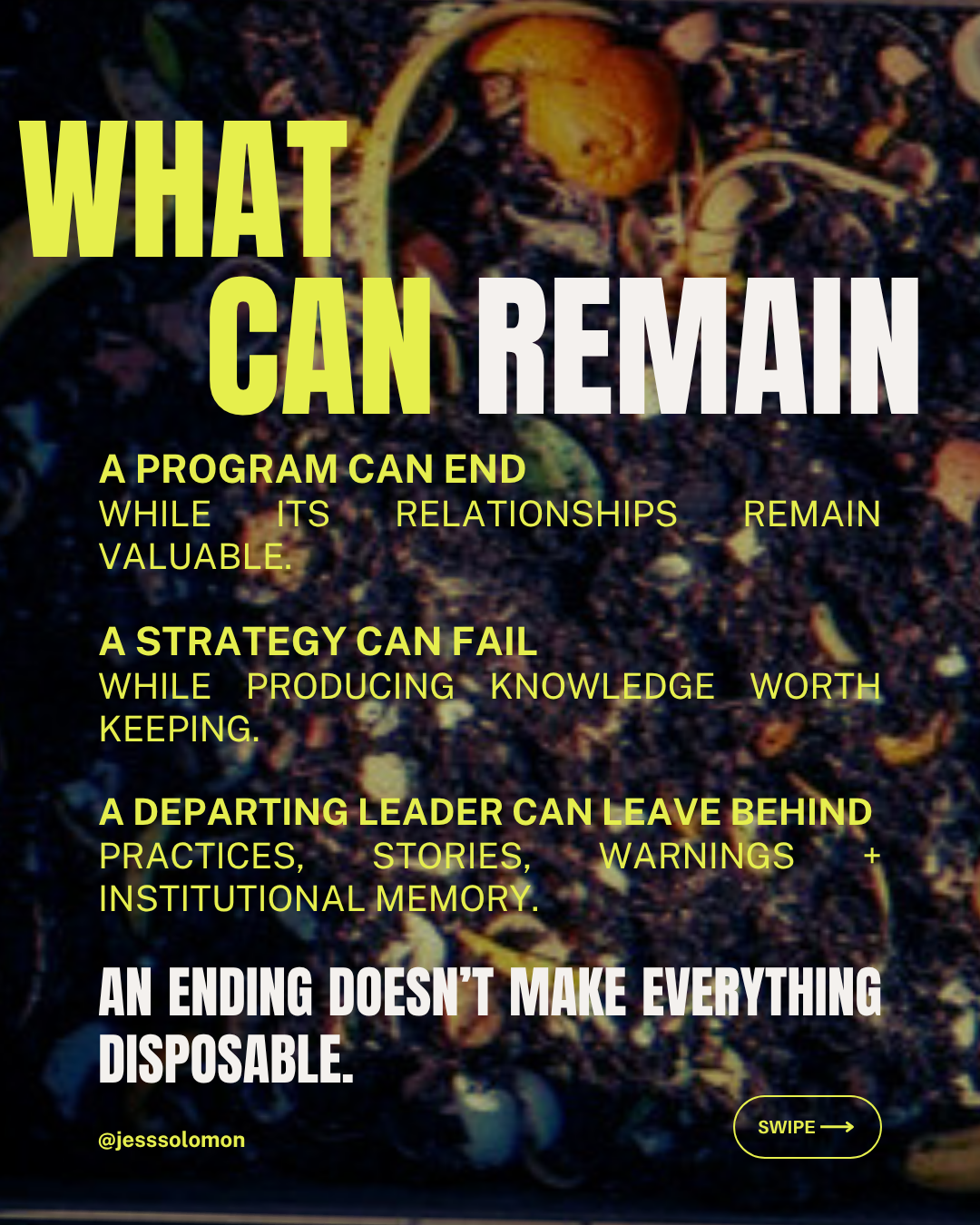
A program can end while its relationships remain valuable. A strategy can fail while producing knowledge worth keeping. A departing leader can leave behind practices, stories, warnings, and institutional memory. A conflict can reveal something about power that an employee survey never could.
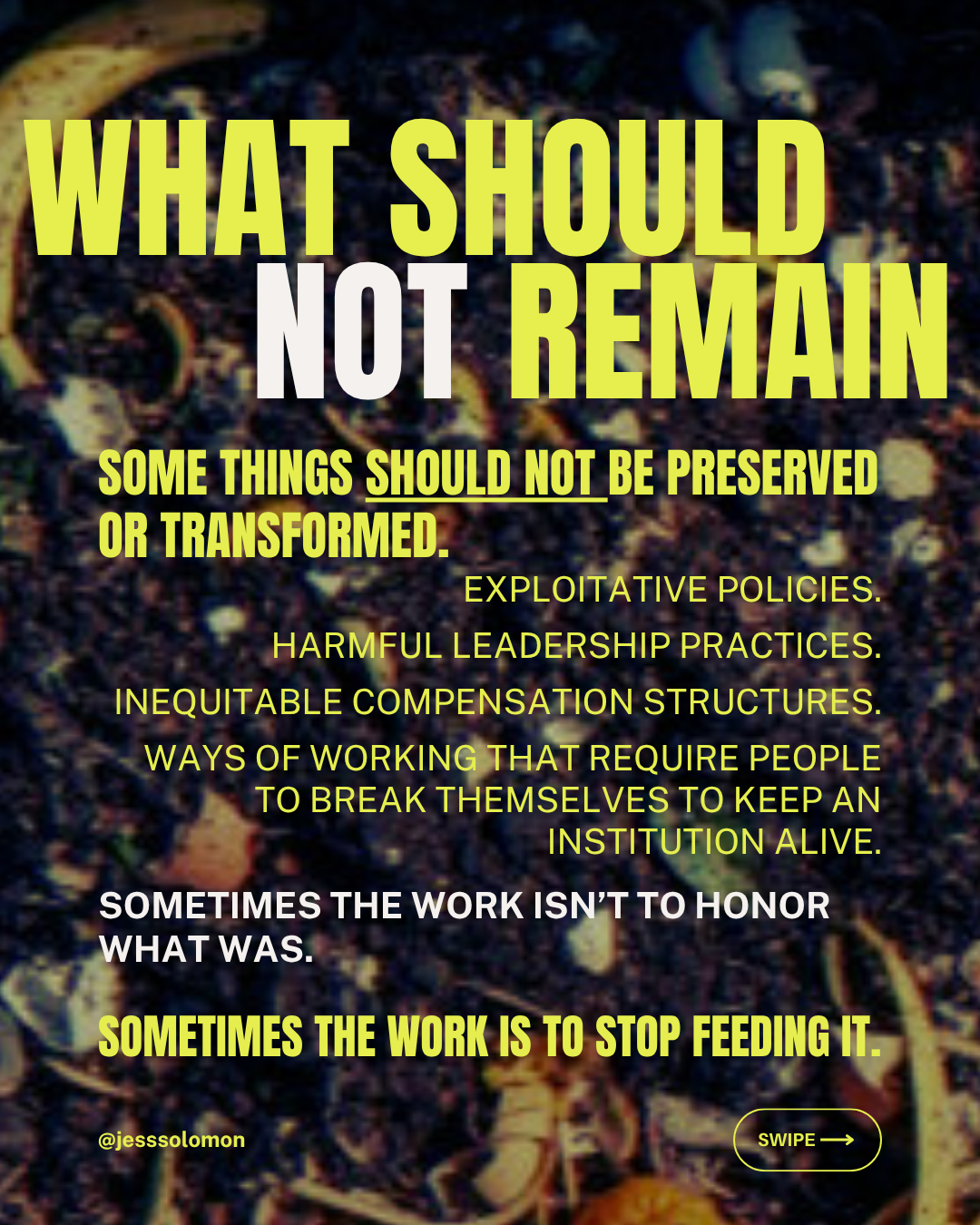
And some things should not be preserved or transformed. Exploitative policies. Harmful leadership practices. Inequitable compensation structures. Ways of working that require people to break themselves to keep an institution alive. Sometimes the work is not to honor what was. Sometimes the work is to stop feeding it.
Composting is the practice of knowing the difference.
It also requires us to accept that decomposition takes time.
You cannot put scraps into a pile on Monday and schedule rich soil for Friday because the board retreat is coming up. Some processes have a metabolic time of their own.
Organizations do too.
Leadership may be ready to move forward while staff are still grieving. Staff may have known something was over years before the board acknowledges it. A strategic plan can be approved before anyone has metabolized what implementing it will require. Different parts of the same organization can be ending, grieving, decomposing, and emerging at the same time.
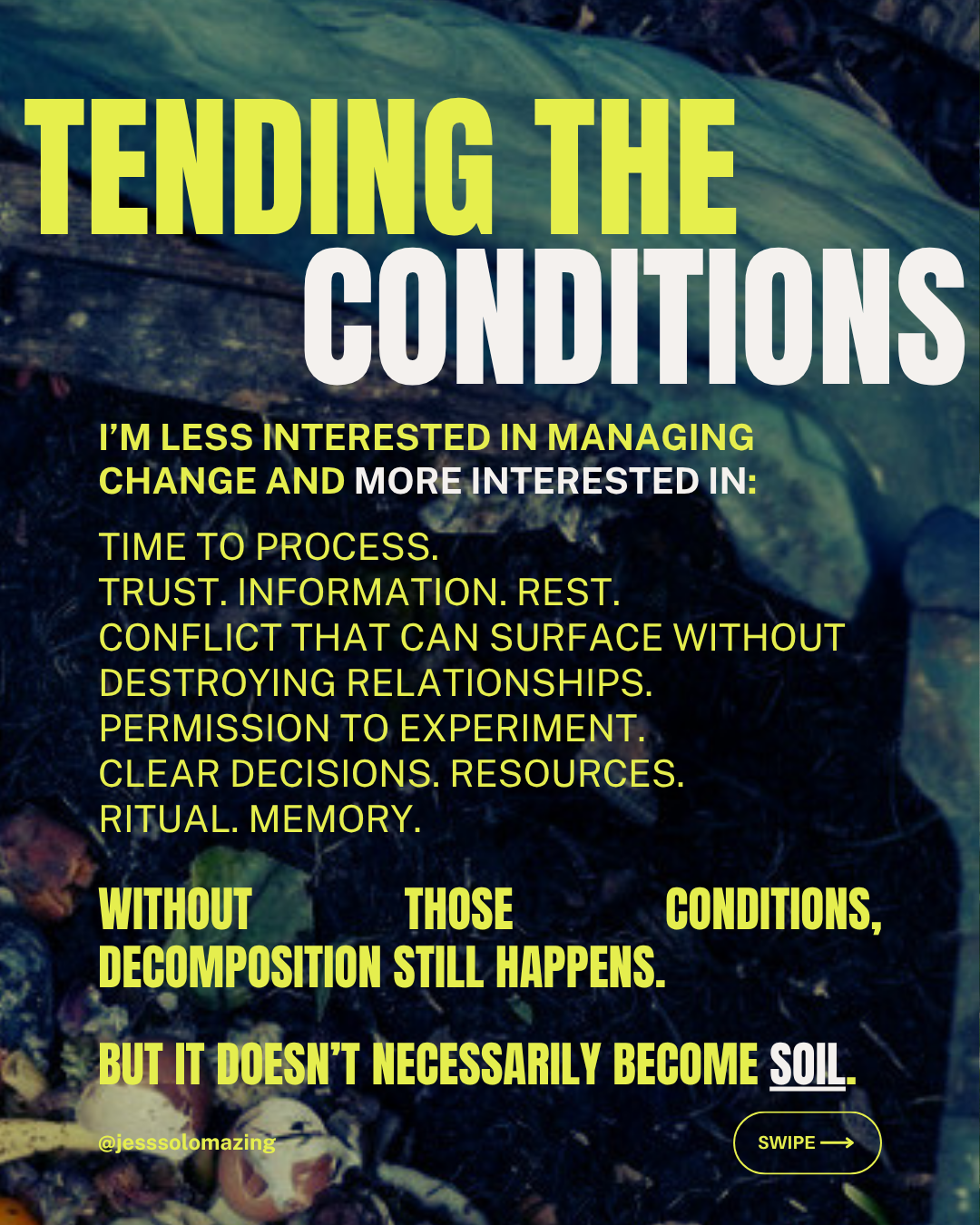
This is why I am increasingly less interested in managing change and more interested in tending the conditions for change.
Time to process. Trust. Information. Rest. Conflict that can surface without destroying relationships. Permission to experiment. Clear decisions. Resources. Ritual. Memory. People whose job is to turn the pile.
Without those conditions, decomposition still happens. It just doesn't necessarily become soil.
I know the difference because I've done it both ways
It's the sixth anniversary of getting on my firm's payroll. This anniversary always brings up grief.
I didn't arrive at this idea by studying organizations from a safe distance. Some of it came from being inside a decomposition process I didn't yet have language for.
In spring 2020, my time in organizational leadership ended abruptly, just as the world entered a global pandemic and institutions were being forced to confront the distance between their missions and their actual practices. I was disoriented. I didn't know yet that I had joined a global sorority of Black women on the glass cliff, class of 2020: elevated into leadership during crisis, expected to repair years of organizational dysfunction with little room for error and constant scrutiny.
My understanding of power was not as precise then. I give myself grace for what I didn't know.
That was collapse. Nobody turned that compost pile.
Six years feels like a chance to be reflective. I've seen some things. I've quit some things. I've built some things. I've blown up some things. I've paid Black women staff, consultants, and contractors well. I've stayed in sketchy work accommodations. I've stayed in five-star ones.
This year I'm celebrating a practice that honors my journey and my gifts, and a business that has composted grief into beauty, strategy, community, and rest.
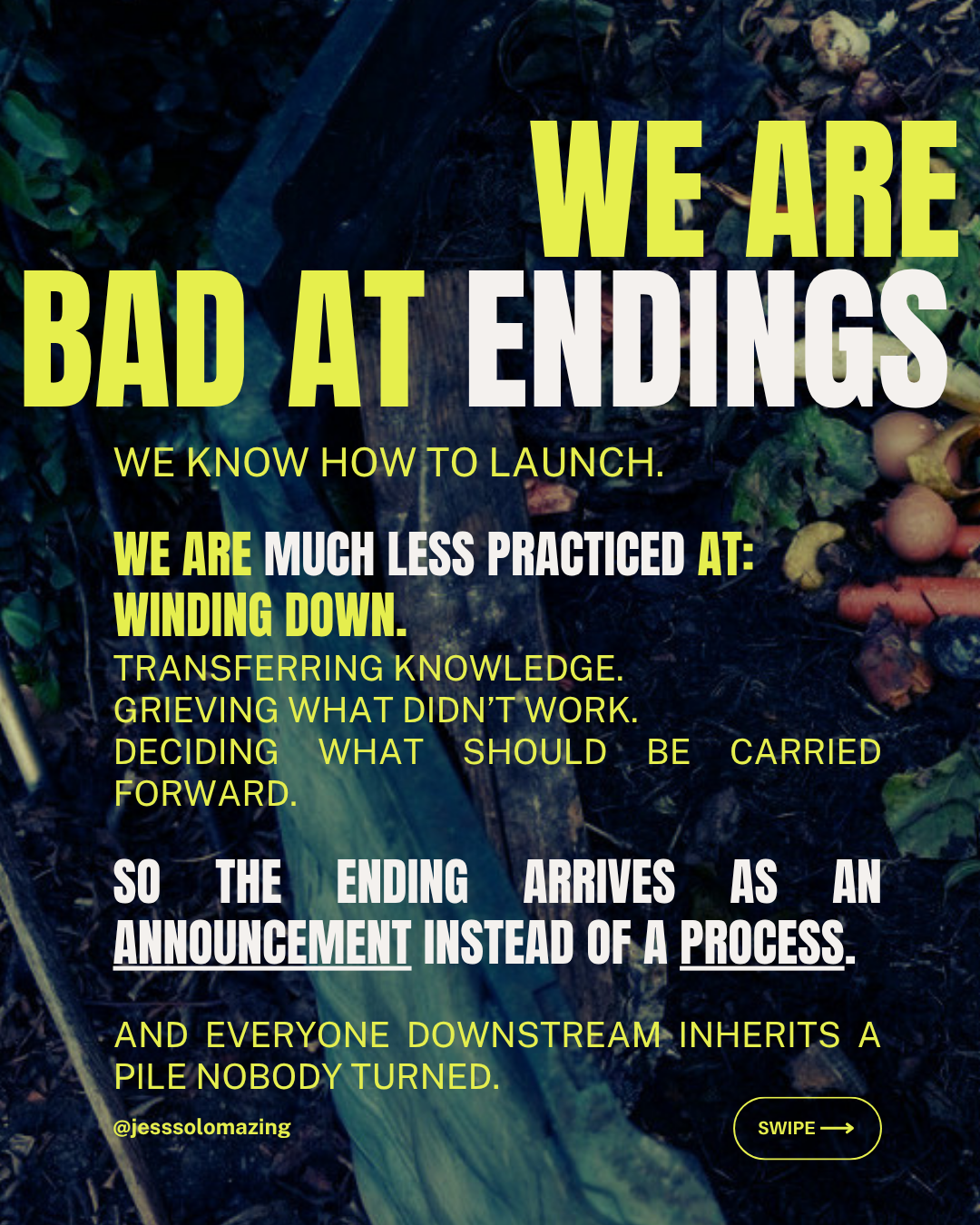
We are bad at endings
Here is the part I'd rather not write.
I have moved too fast on some endings. When a staff relationship or collaboration needed to close, I sometimes wanted to move through the discomfort quickly. I told myself I was being decisive. Sometimes I was. Sometimes I was skipping the harder work of naming what wasn't working before deciding it was over. A few of those closures were rougher than they needed to be, and some of that roughness was mine.
Six years later, I believe endings deserve the same intentional design we give beginnings.
We know how to launch. We have timelines, kickoff retreats, ribbon cuttings, press releases, and consultants like me on speed dial. We are much less practiced at winding down, transferring knowledge, grieving what didn't work, or deciding what should be carried forward. So the ending arrives as an announcement instead of a process, and everyone downstream inherits a pile nobody turned.
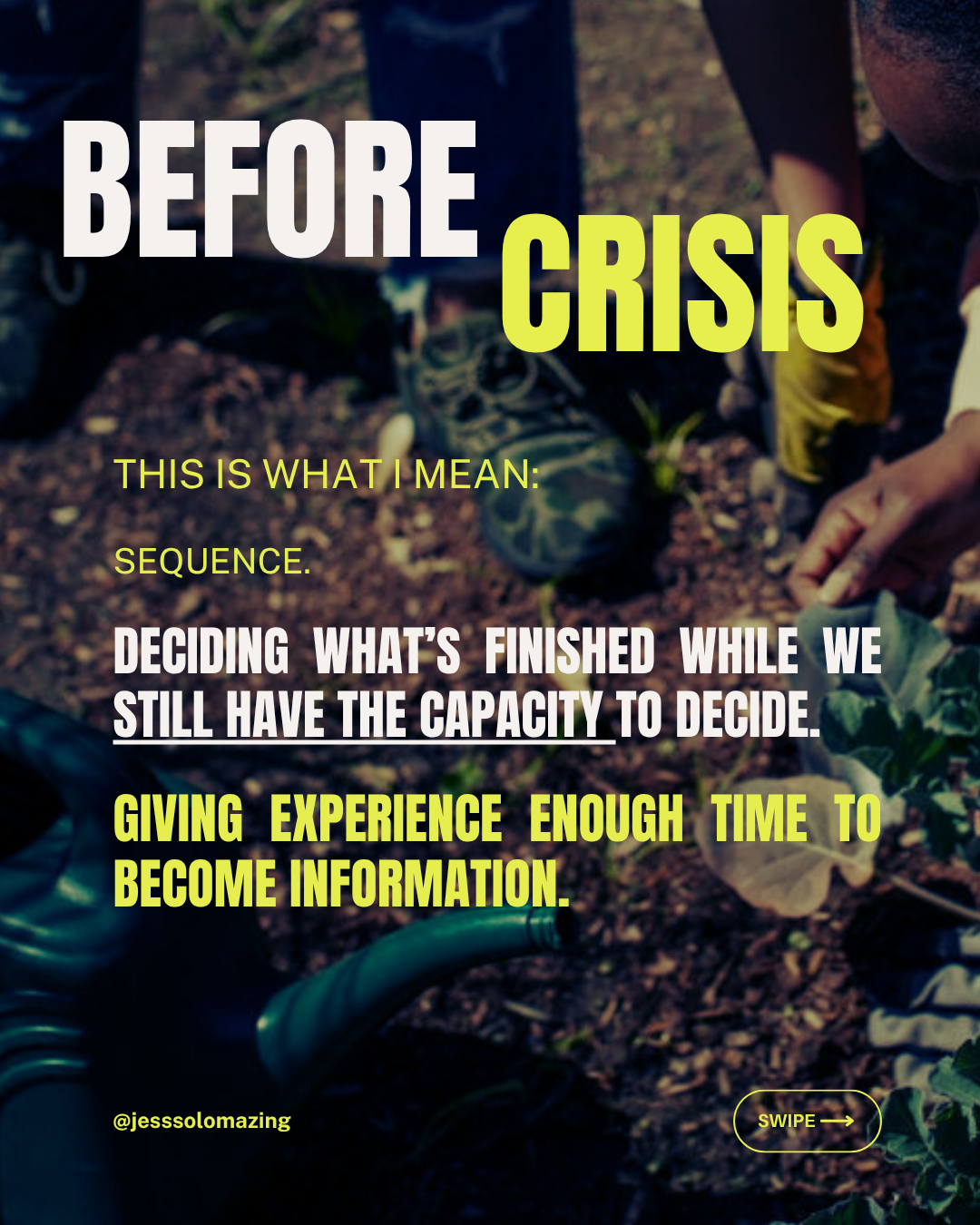
This is what I mean by composting before crisis. Not optimism. Sequence.
In my own practice, that has meant buffer weeks between contracts, recovery time built into my calendar before I need it, and writing down what I learned before rushing toward the next thing. Small practices that give experience enough time to become information.
They don't slow down the work. They slow me down enough to make better decisions inside it.
What grew
And a lot has grown in six years.
I've designed and facilitated gatherings, leadership transitions, organizational change processes, and experiments with amazing people across the country trying to build institutions worthy of the people inside them.
This year, I returned to the Bay Area Cultural Funders for Equity's Crisis Fund, helping move $2.2 million toward organizations navigating burnout, grief, political targeting, underfunding, leadership transitions, and cumulative strain. That work sharpened a question I keep carrying: How might we design systems around the conditions people are actually living in?
With Building Movement Project, I designed and facilitated the Solidarity + Care Lab, exploring what changes when care becomes infrastructure for solidarity rather than an afterthought. I've also started making some of the invisible frameworks I've developed over these years portable, including Facilitation Archetypes.
And I've been studying stand-up comedy in earnest through Mabley Comedy Club and on festival stages. Comedy keeps teaching me something my organizational work has been teaching me too: laughter belongs beside grief. Not because it erases grief, but because it helps us carry it.
Looking back, I can see that these things aren't as disconnected as they once appeared.
They are all questions about culture. About what people do under pressure. About what we inherit, what we practice, what we release, and what becomes possible when the conditions change.
Culture Rules Everything
My former company, Art in Praxis, is composting.
Years of client partnerships, experiments, mistakes, frameworks, relationships, and learning are becoming nutrients for what's growing now.
Culture Rules Everything isn't a consulting firm with a new name. It's a multidisciplinary studio built on one conviction: culture is infrastructure. Culture is the operating system underneath every meeting, policy, conflict, ritual, and decision.
My work now is helping people understand the codes running underneath their organizations and communities, and tending conditions where people can make better decisions, move through tension, remember what they've learned, grieve what has ended, and imagine what might come next.
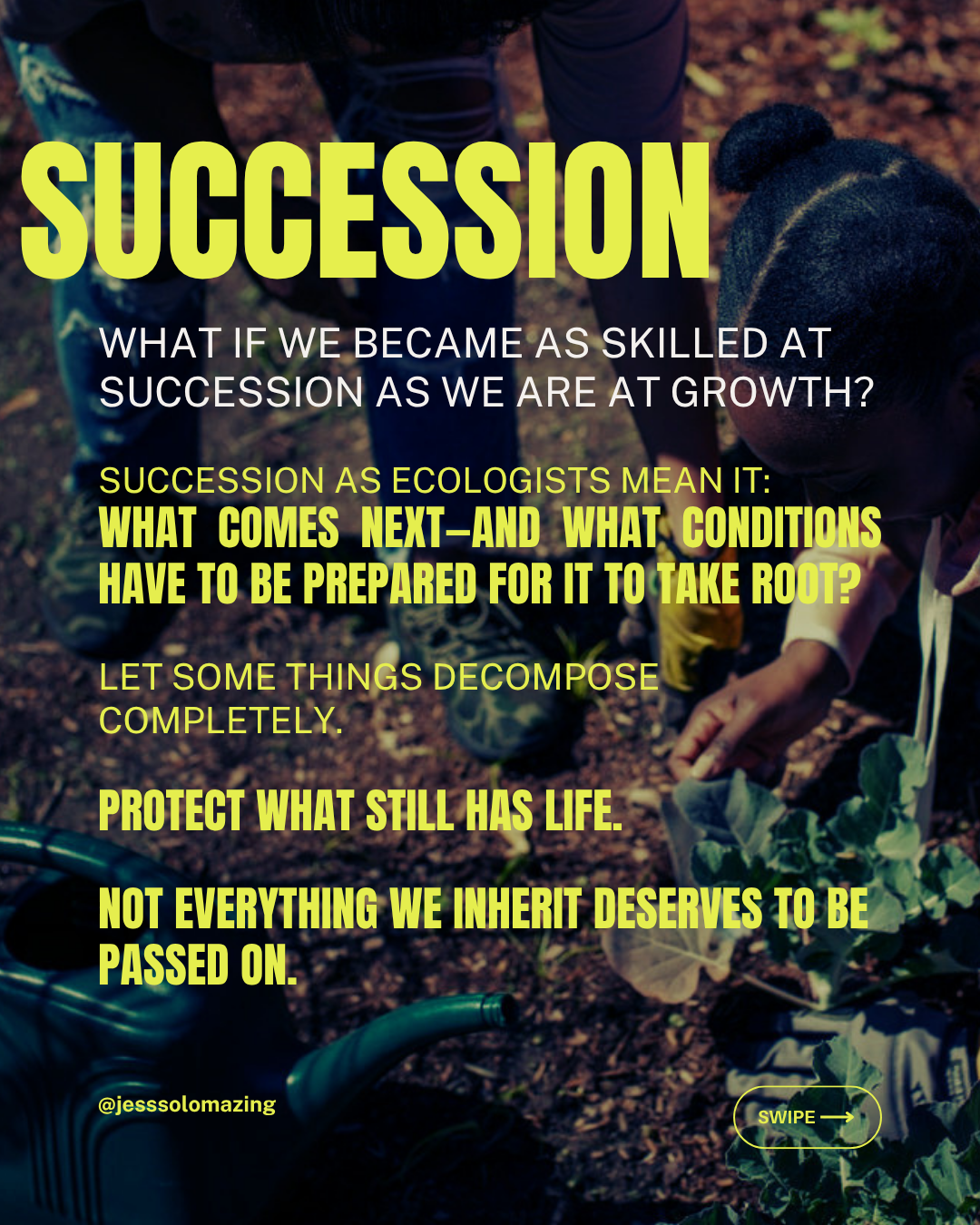
What I want for the next six years is for this field to get skilled at succession.
Succession as ecologists mean it: what comes next, and what conditions have to be prepared for it to take root.
That means deciding what's finished while we still have the capacity to decide. Turning the pile on purpose, with hands and time budgeted for it. Tolerating the heat. Letting some things decompose completely. Protecting what still has life in it. Remembering that not everything we inherit deserves to be passed on.
And doing this work before crisis makes the decisions for us.
I don't know exactly what institutions we will need six years from now. I don't know which of the ones we have now will still be here.
But I want us to become better stewards to whatever comes next.
To leave behind more than organizations that survived.
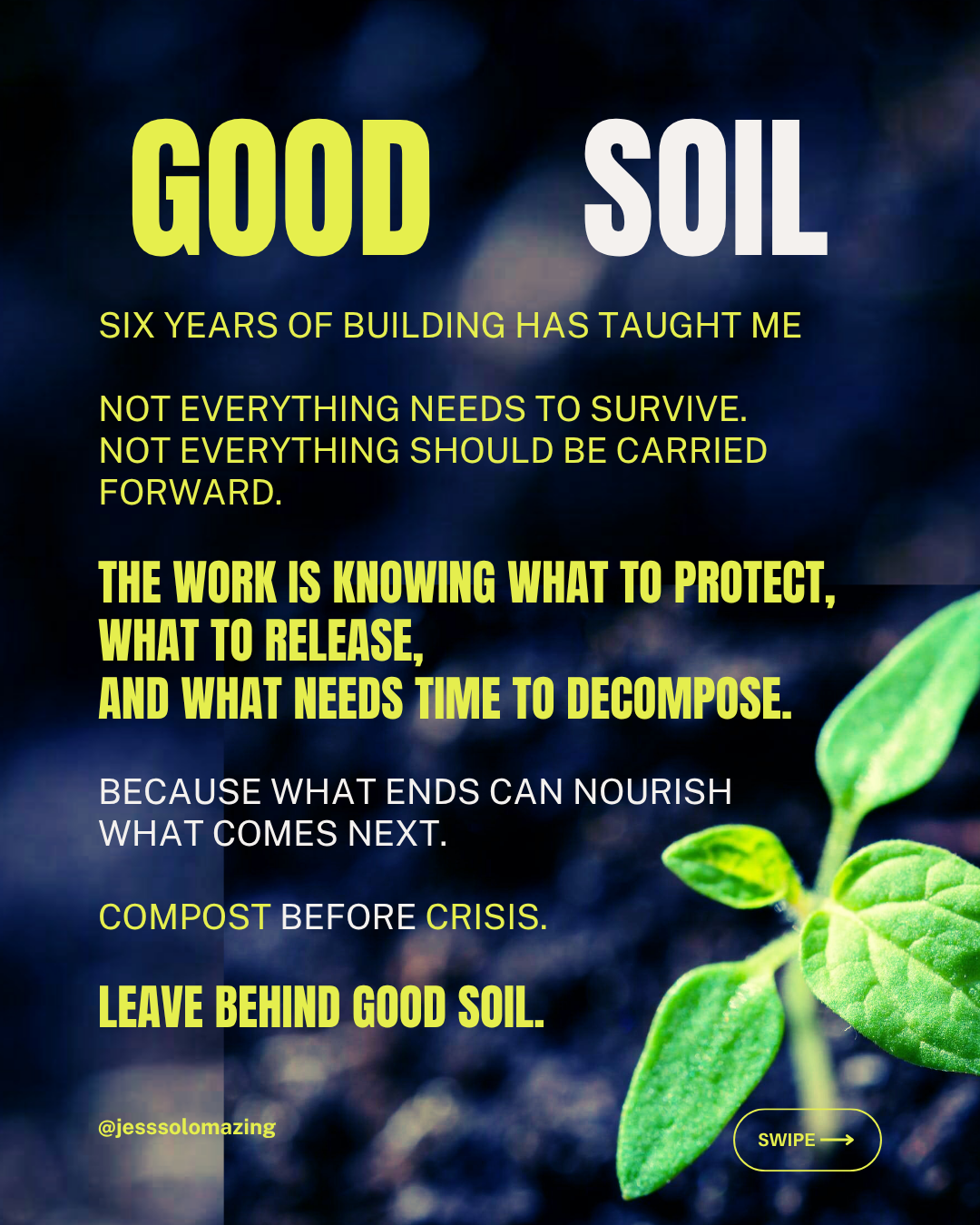
To leave behind good soil.
A resource for tending organizational grief
For those wanting to go deeper, I recommend Navigating Organizational Grief with Richael Faithful and Griffin Moore, a practical framework for helping organizations acknowledge, make meaning of, and integrate collective grief rather than allowing it to remain untended in organizational culture.
If something in your organization is ending
If you're reading this from inside an ending, whether it's a leader stepping away, a program winding down, a merger already decided, or a strategy that quietly stopped working, you probably already know what needs to be turned. What's usually missing is time, sequence, and someone whose job is to turn the pile with you.
That's the work. I offer a 45-minute discovery call to hear what you're facing and talk through what kind of support the moment calls for.