Your Staff Is Not Resisting Change. They're Responding to Conditions.
One of the core misunderstandings I encounter in change work is that when change fails, people are at the center of the problem. They're not. The conditions are.
Many organizations treat transition as primarily a communication or implementation challenge. Get the messaging right. Build a rollout plan. Reduce friction. Get buy-in.
Those things absolutely matter. They're just incomplete.
Because people don't experience organizational change as a flowchart. They experience it as confusion, loss, ambiguity, power shifts, new language, unclear expectations, and maybe the 37 competing Slack messages with no obvious decision-maker in sight.
They experience it through the organization's culture — what gets said, what gets avoided, who gets protected, and what the room feels like when leadership walks in.
The cost people are actually calculating
Years ago, organizational theorists Richard Beckhard and Reuben T. Harris proposed a change equation: people shift when dissatisfaction with the current reality, belief in a different future, and confidence that change is practical outweigh the perceived cost of changing.
C = (ABD) > X
(Where C = Change, A = dissatisfaction with the status quo, B = desirability of the proposed change, D = practicality of the change, X = cost of changing.)
It's a useful frame. But I think organizations often misread what "cost" means.
The cost people are calculating is rarely just operational. It's relational. Psychological. Political. Economic. People are quietly running numbers on questions like:
What happens to me if this change fails? Where does power shift (and to whom) while this is in motion? Will I still belong here on the other side?
And here's the part that doesn't show up in the rollout plan: culture teaches people how to answer those questions long before leadership announces a new strategy.
If the culture already feels punitive, scarcity-driven, opaque, or performatively aligned, even good change can feel threatening. The organization becomes the context through which every decision gets interpreted. And that context either makes change survivable or it doesn't.
What I think "resistance" is actually telling you
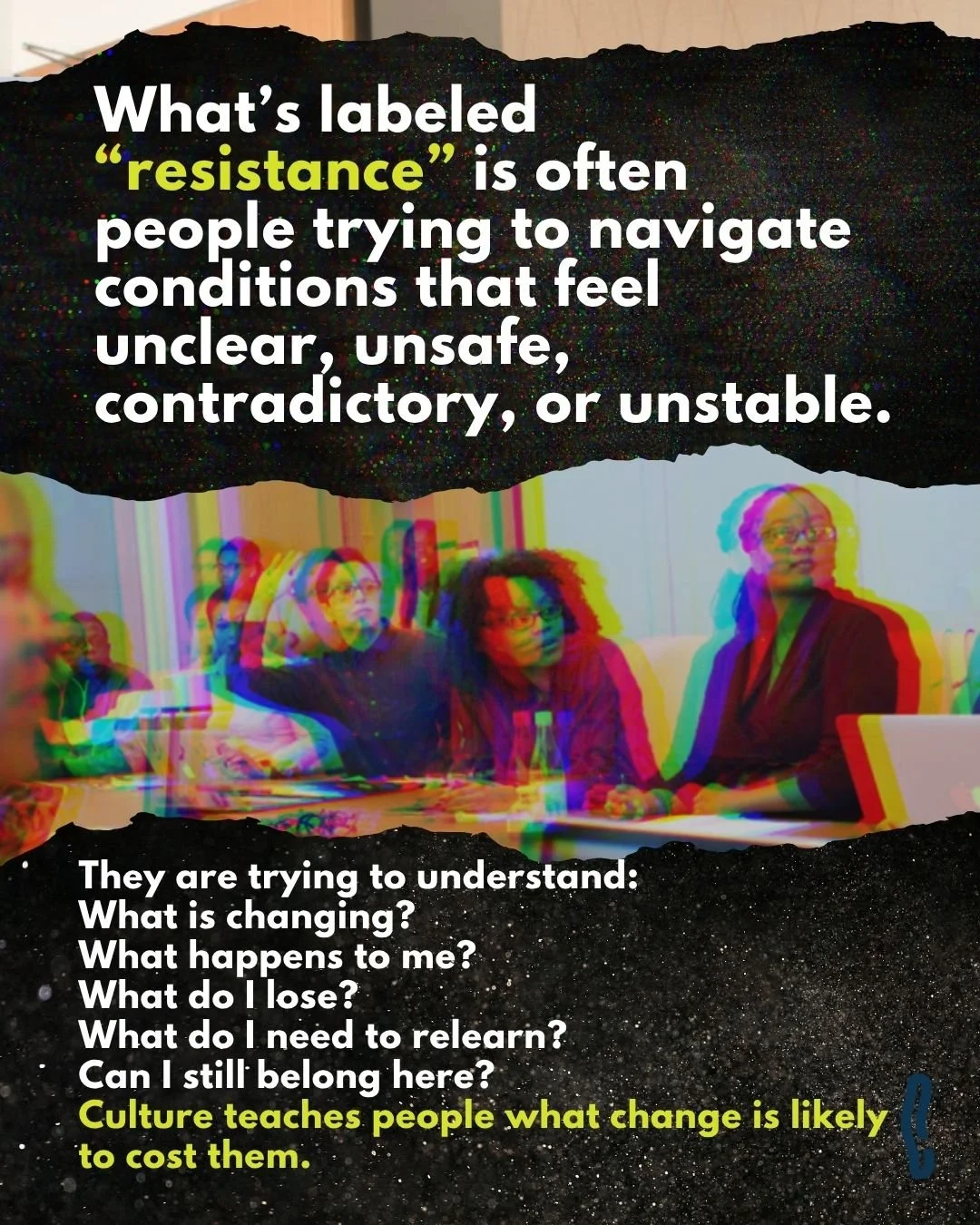
I've been in enough rooms to know: what gets labeled resistance is often people trying to navigate conditions that feel unclear, unsafe, contradictory, or unstable.
They're not against change. They're doing the same thing every intelligent organism does when the environment shifts: assessing risk, looking for signals, trying to figure out whether this new thing is survivable.
In multiracial and multicultural organizations, which is most of the organizations I work with, this gets layered with people carrying lived experience of precarity, exclusion, over-functioning, and institutional betrayal. They've watched change initiatives come and go. They've been told to trust processes that didn't protect them.
That's not resistance. That's information for you, telling you something about trust, clarity, power, and whether the future being proposed actually accounts for the people being asked to inhabit it.
What you do with it is the work.
A Lesson from Beyoncé
I use the Beyoncé Renaissance World Tour as an example in workshops because it was a genuine cultural phenomenon, and a good time.
There's a moment mid-concert when Beyoncé commands the crowd: "everybody on mute." And we did it. Tens of thousands of us, in arenas around the world, went silent on cue. Phones down. Voices hushed. The whole room holding its breath together before erupting in celebration that we did it!
That level of collective coordination didn't happen because of a good announcement. It worked because the conditions for coordination already existed: shared language, shared attention, trust, participation, practice, timing.
Organizations attempt transformation without building any of those conditions first. Then they wonder why alignment never arrives.
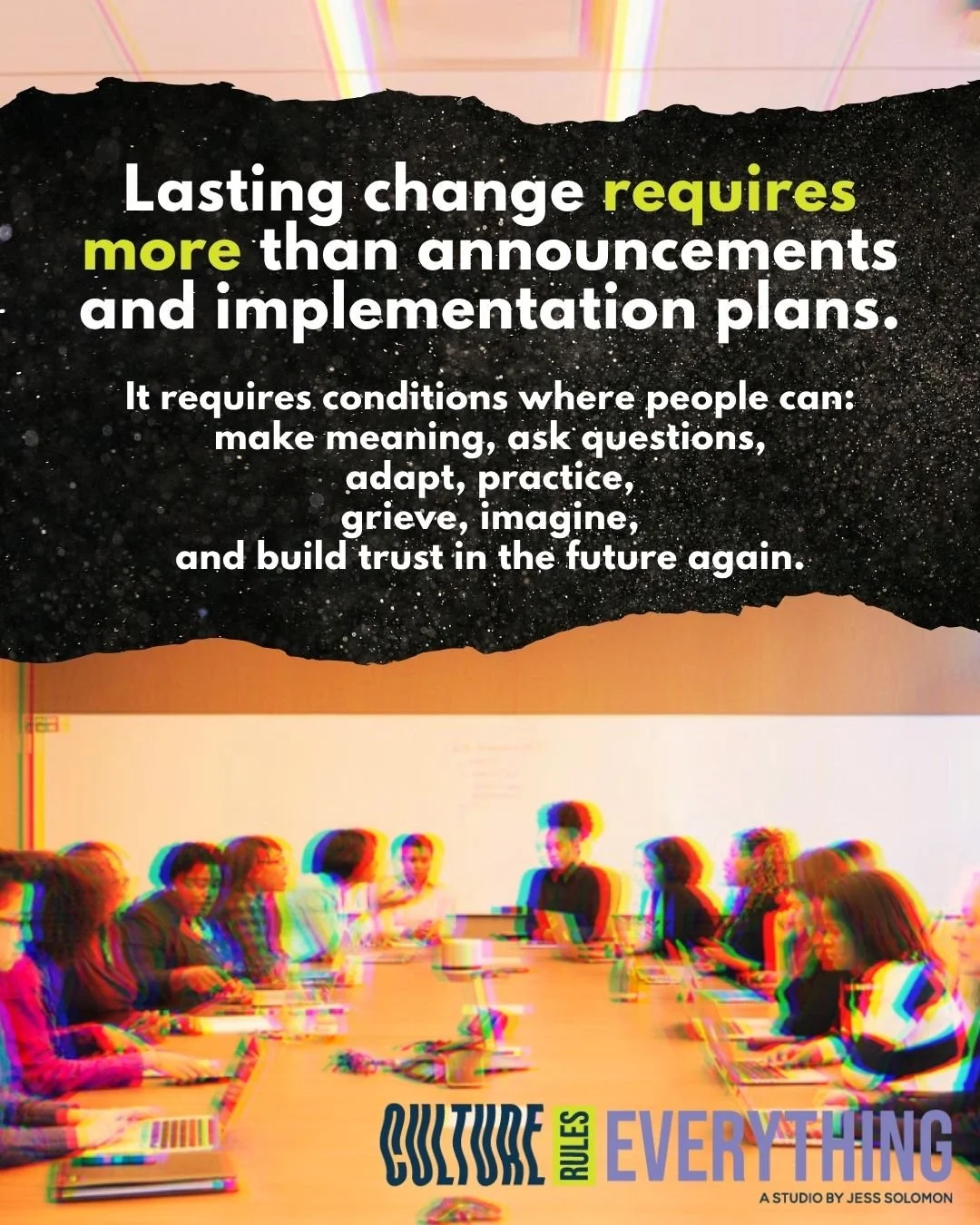
Lasting change requires more than announcements and implementation plans. It requires conditions where people can make meaning, ask real questions, practice new behaviors, grieve what's being lost, and build enough trust in the proposed future to actually move toward it.
That's the work underneath the work. It's slower. It's less legible on a Gantt chart. And it's where most change efforts run out of runway.
What this means for practice
A large part of my work at CRE is helping organizations navigate exactly these moments: leadership transition, restructuring, culture fracture, team instability, governance shifts, periods where the old ways of operating are no longer holding.
The questions I'm most interested in aren't what are we changing and how fast can we move. They're:
What are people experiencing while the change is happening?
What conditions are shaping those experiences?
How is power operating beneath the surface?
And what becomes possible if we redesign those conditions with intention?
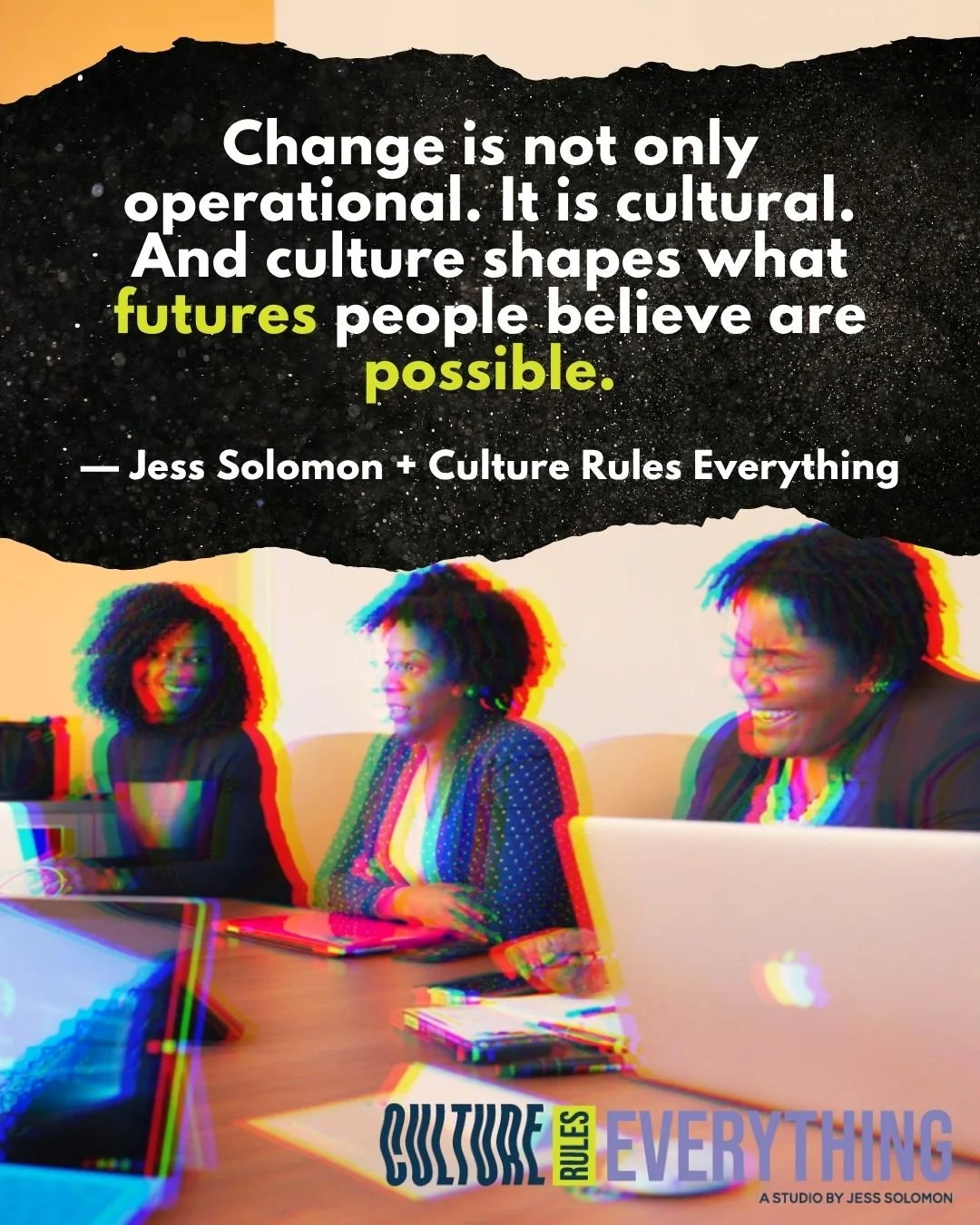
Because culture is not soft. Culture is infrastructure. And infrastructure shapes what futures people believe are possible.
This post grew out of a recent IG carousel — if you found your way here from there, welcome. If you're navigating a transition in your organization and want to think through the conditions question, let’s talk hi@cultureruleseverything.com.